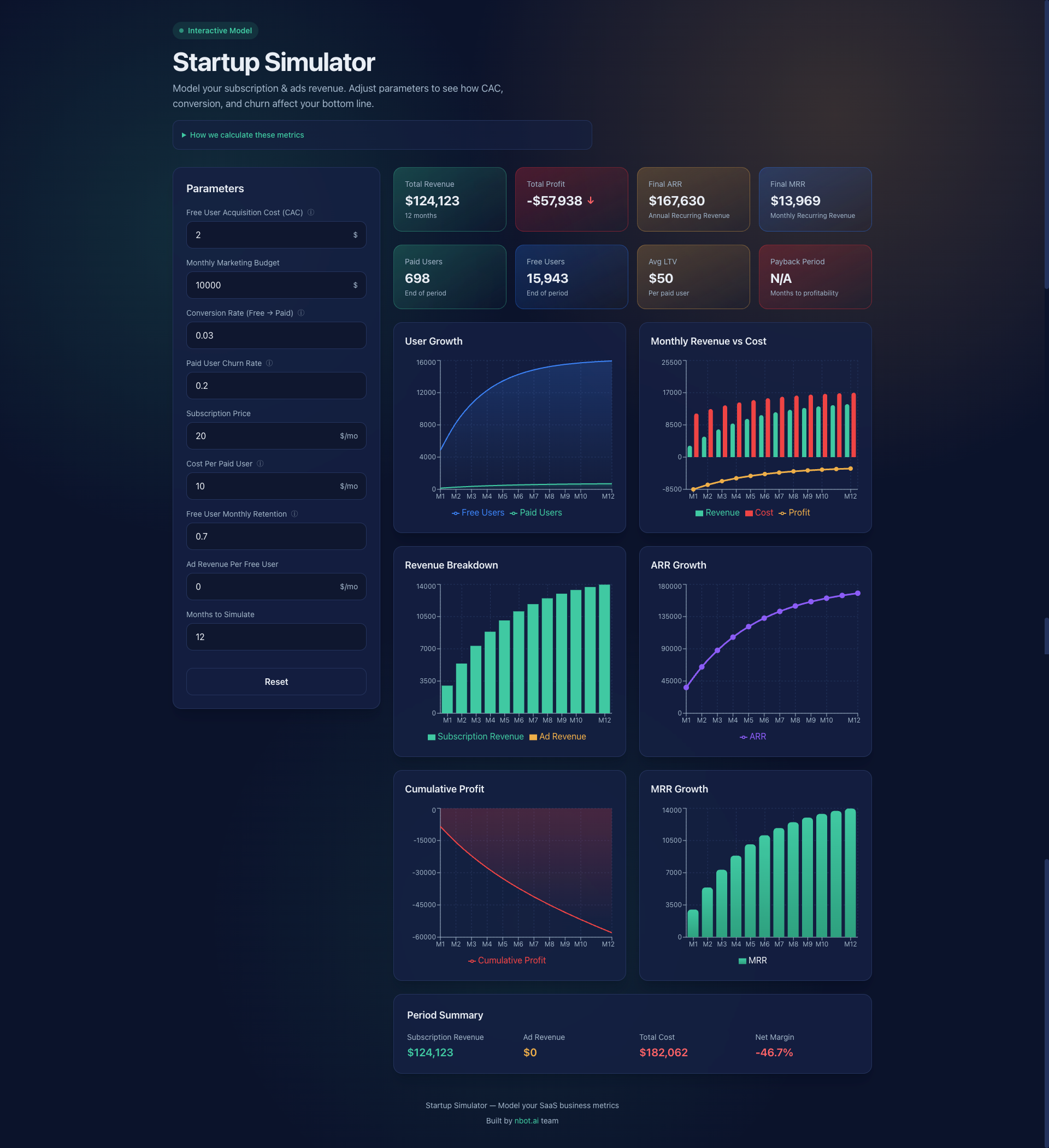
Life has been busy and I barely had energy to watch AI updates. I wrote half of last week’s (12.05) notes and never finished, so here comes a catch-up after two weeks away. Last week saw a bunch of new models or reports: DeepSeek, Mistral, QwenVL. I skimmed DeepSeek-3.2’s report and nothing really grabbed me; Mistral feels forced, with the only bragging point being a programming win among open-source models, which still needs community validation. I mostly glanced over these. GPT-5.2 rumors are everywhere this week but nothing is out yet. Competition is intense and releases may become more cautious. With that set aside, let’s talk about how hard (AI) consumer products really are. I’ve been pounding the calculator to forecast next year’s metrics for a project. It’s my first time doing this, so it’s been oddly fun. Over the weekend I vibe-coded a startup simulator to make the impact of each lever obvious. The calculator is deployed on Vercel, and the code is open-sourced: startup-simulator. Feel free to play with it.
The ultimate metrics for AI or internet products are user base, revenue, and cost; revenue minus cost equals profit.
In a simplified model, user base depends on three things: user acquisition cost (CAC), acquisition budget, and retention. With paid traffic, budget divided by CAC is your new users per time unit, and retention is how many of your existing users remain after a time period. If new users during that period exceed churn, users grow; otherwise, they shrink. In the US, a fairly normal app CAC is a few dollars, meaning 1,000 installs via ads cost several thousand dollars. Website clicks are cheaper, but web retention is much harder than app retention. Zero-cost hacks exist—if Musk shouts about a new product on Twitter/X, users pour in. Traffic is currency.
Cost has a few parts: acquisition is the big one, and classic serving costs like compute and bandwidth are smaller. Internet scale usually lowers per-user serving cost, but CAC often works in reverse: the more you spend, the higher the marginal CAC. AI breaks the pattern again—serving each user consumes tokens. A $20 OpenAI subscription doesn’t even cover token costs for a heavy user.
Revenue sources include ads, subscriptions, and commerce. Most products live on ads; AI apps are seeing more subscriptions. Ad revenue correlates with impressions and user count, and you can model revenue per user to compare against CAC and serving cost to see whether adding a user makes or loses money. Subscriptions come in two modes: paywalled or freemium. Freemium needs a conversion rate from free to paid. For AI products, subscriptions are now the norm, and most still avoid ads.
Let’s run a few examples for intuition, all on monthly periods for simplicity.
If CAC is $1, you spend $10k a month, and month-2 retention is 50%, by month 12 you will have acquired 120k users historically but end up with under 20k active. Keep the same budget and growth flatlines.
In that scenario, double the budget to $20k/month and you stabilize around 40k users, also without growth. Because of churn, holding a steady state costs real money; the steady state size scales with budget.
If retention rises to 60%, you finish with roughly 25k users after a year, but growth still slows sharply.
Suppose we build an AI app at $20/month. Free-to-paid conversion is 5% (ChatGPT level). Paid users cost $20/month in inference on average (already lowballing), and free users cost $2 each to acquire, whether through tokens or ads. Because the product is actually good, free users have little reason to churn, so month-2 retention is 70%; paid users still cancel sometimes—call it 80% retention. Spend $10k/month and after a year you have ~15k free users and ~1.2k paid. Annualizing month-12 revenue gives ARR of ~$280k. Over the year you burn ~330k and collect ~210k, losing ~120k.
If your product isn’t as strong as ChatGPT and conversion drops to 3% with everything else unchanged, paid users fall to ~600, ARR to ~$170k, and the yearly loss is still ~$120k. For many AI apps, both revenue and cost scale with users. With a fixed free-user acquisition budget, conversion doesn’t change total profit much but it dictates paid scale—low conversion means the business stays small.
All of the above lose money—basically you burn what you spend. How would OpenAI make a profit? Two options: lift gross margin by driving inference cost under a quarter of subscription price so the model above flips to profit, or add ads to earn another revenue stream. That’s what OpenAI and Perplexity are trying.
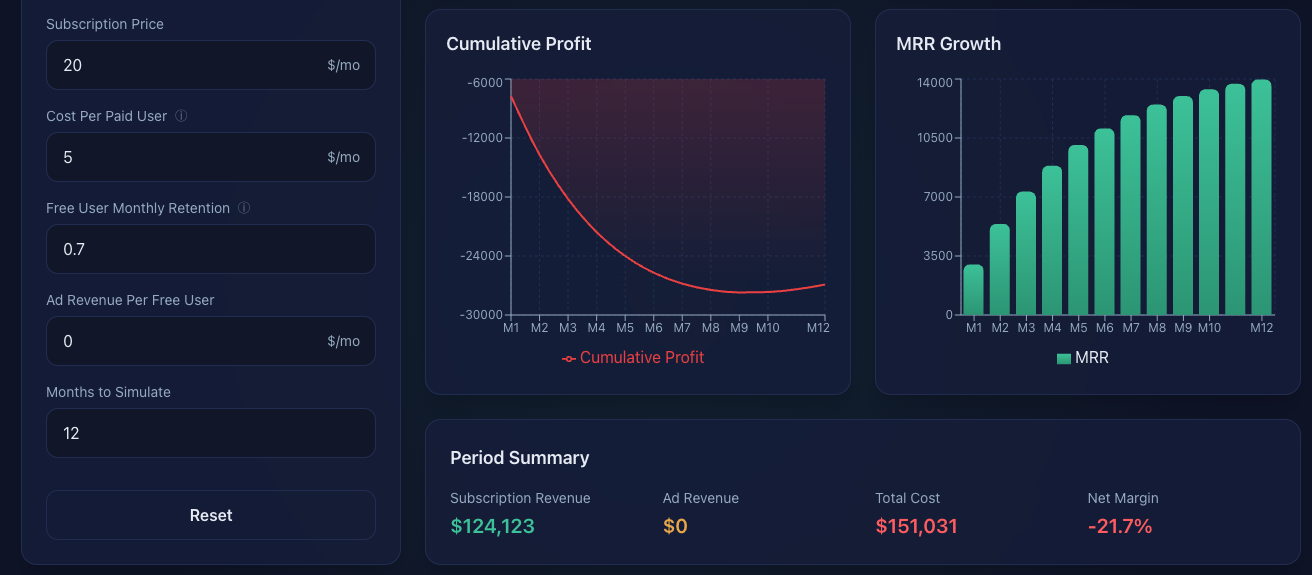
None of the math above includes headcount costs. Add them and profitability is brutal. Everyone talks up ARR, but actual profit might not even be on the horizon.
Feel free to try the simulator. That’s it for today—next post will be from UTC+8.