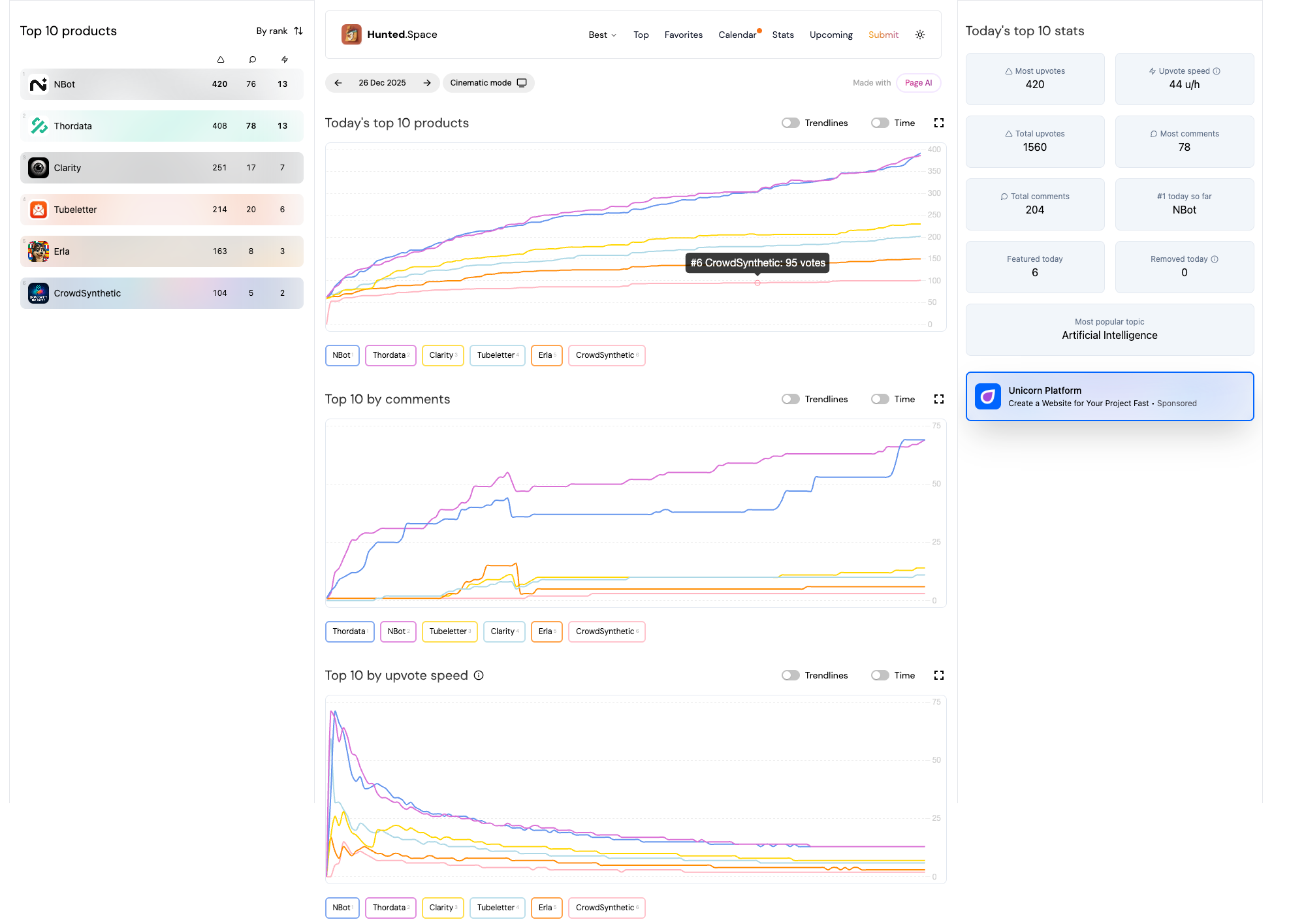
NBot took first place on Product Hunt’s daily board.
It’s a product we spent two months building and launched over the Christmas holidays. The timing was partly because of delays and partly because competition is lighter during the break. We’re happy with the result, but the whole process gave me a much clearer view of growth for AI products.
Product Hunt Isn’t as Easy as It Looks
Posting on PH is easy; placing well is not. The leaders invest real time and money—votes have to be campaigned for.
Search Product Hunt on LinkedIn or Facebook and you’ll find plenty of groups, some quite large. Announce a launch and you’ll get swarmed by marketers offering to push ads. PH’s anti-cheating is strong: brand-new accounts don’t count; you need to age them before votes carry weight. That cuts most vote-buying, but it’s still possible if you know the right circles.
We ended up with 400+ visible votes but must have reached well over a thousand people. Many votes vanished on refresh—invalid. You feel like the whole world voted, yet the number doesn’t move. Surreal.
If I did it again, the best move would be connecting with recent makers. Their accounts have weight and can deliver reliable votes. If you’re a serial founder or a “star” maker, it’s way easier. We were short-handed and didn’t do enough outreach—and the response rate is low, which is time-consuming.
PH’s Real Value Is Credibility
Based on what we see, PH traffic converts okay; people tend to try the product. But many PH regulars are devs or CEOs, not necessarily your target users.
So a good PH rank is more of a credibility badge. Once you place, lots of sites and newsletters automatically pick you up; search “Product Hunt” on WeChat and you’ll see plenty of these articles. That helps SEO with extra backlinks.
Speaking of backlinks, there are many AI-tool directories now—TAAFT (There’s An AI For That), Toolify, etc. Getting listed costs money, from tens to hundreds of dollars; you get backlinks and some traffic. We paid a few dozen dollars to try one—it worked but wasn’t amazing. I was honestly shocked when I first saw this model; didn’t expect people to make money this way.
Everyday Operations Matter More
Those are one-off moves; day-to-day operations matter more for growth.
Cash-strapped indie hackers can build a Twitter account or post on Reddit—the most AI-heavy places right now. “Build in public” is a hot idea: grow your persona and your product at once, but execution is hard and demands daily time for replies, ideas, and posts.
You can do other platforms too, especially if you’re good at content. Zara Zhang is a typical case: she shared AI product notes on Xiaohongshu, then launched her own side project. With traffic, building products gets easier.
If you have budget, you can pay creators for posts—influencer marketing. Let them share their experience; they know what engages their audience, and a diverse set of creator posts reaches different users more easily than your team’s own posts.
AI products have low onboarding friction and make fun demos, which fit influencer marketing well.
Million-Dollar Influencer Marketing
I interviewed a student who interned at a top AI agent company—you’d know the product. That massive buzz was basically one GTM lead plus two interns hunting down countless creators. She’s only an undergrad and spent over a million dollars in a two-month internship.
Budgets are huge, and plenty of creators are mediocre but still charging. The whole space is exploratory; having someone willing to bankroll experiments is both luck and capability. Handling a budget that big takes skill and nerve.
I don’t think she fully grasps how valuable that experience is. Few people ever get to spend that much on one initiative. She’s not the only one who could do it, but she happened to be there, took the hits, learned the ropes, and now has a big edge over peers.
Content Is the Product
Is it better to build traffic first then make a product, or build the product first then find traffic? I increasingly think the former is smarter.
Content is product, with a short feedback loop. Publish a piece and you see reactions the same day; build a feature and it can take weeks to know if users care. Writing also clarifies thinking—clear writing means clear thinking, which is critical.
I highly recommend writing and watching feedback. This series has run almost three months; readers rarely interact (I’d love more!), but at least I see view counts. The last post about vibe-coding interviews was my most-read ever—thanks to Ruan Yifeng for featuring it in his tech weekly.
The Essence of Growth Hasn’t Changed
GTM or growth in the AI era isn’t that different from the internet era. Vibe coding gives individuals and small teams more chances to build products, so we see more growth tactics tailored to indie developers.
If you want to burn budget, traditional ads are always there. Ad slots across traffic products await your bids, not to mention real-world billboards. Ant Group’s “Afu” ads are everywhere; by comparison, the Bay Area has a richer mix of AI ads—B2B and B2C—feels like AI companies are close to blanketing San Francisco’s billboards.

Back to us: NBot has slightly more cash than an indie hacker, but we care a lot about efficiency. PH #1 is a nice start, but it’s a one-off. The next challenge is daily ops—finding real users with limited resources.
This echoes the 10.26 note: efficiency isn’t direction. AI makes building easy; finding users is still hard. PH gave us a badge, but the road ahead is long.