Saw a concern on social media today.
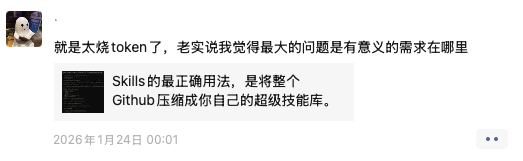
It’s both right and wrong. Demand hasn’t magically appeared out of thin air, but suppressed demand is being unleashed. I’ve had a realization lately: AI creation—coding, image generation, video generation—is like the new liberal arts of our era.
Technique Is No Longer the Barrier
Donald Knuth’s famous The Art of Computer Programming says it in the title: programming is an art. Good programs aren’t just useful—they’re beautiful. Setting aside internal implementation, which requires some appreciation to enjoy, a beautiful UI should appeal to everyone.
But arts like music, chess, calligraphy, and painting share a trait: mastery requires massive practice. Programming is the same. Many people have excellent imagination with vivid pictures in their minds, but limited technical skills prevent them from expressing what they envision.
I’m a backend engineer who didn’t know much about web development. But I think my taste is decent—I can appreciate well-designed websites. Now with AI coding, I can direct it to create beautiful frontend pages. Multimodal capabilities make it even easier; I can just screenshot and tell the AI what to change. It’s really like working with a frontend engineer.
As long as you can envision it, articulate it clearly, and care enough to refine the details, AI can help you execute well. The technique barrier is suddenly broken, and ordinary people have a chance to create works that match their imagination.
Unique Emotional Value
I’m a very amateur guitar hobbyist, but that doesn’t stop me from loving the instrument. Picking it up and strumming a bit makes me happy. AI coding offers similar pleasure—using and admiring work you co-created with AI doesn’t require an audience applauding.
But thinking carefully, these two kinds of joy are actually different.
Playing guitar feels like “I’m getting stronger”—delayed gratification, bitter before sweet. Directing AI rarely feels bitter; more often you think “why is this AI so dumb?” The satisfaction from guitar comes from “I can do it now”; the satisfaction from directing AI comes from “it actually worked” or “we really made it.”
Compared to traditional arts, directing AI also offers a unique sense of control. As long as you can afford tokens, AI never refuses your requests, and it works fast. Of course, AI rarely sparks mutual inspiration like a great frontend engineer or designer would. Pleasant surprises happen, but they’re luck.
Two Views on “Authenticity”
Some might say that things made with AI don’t have the same “authenticity” as code you wrote yourself or a song you played with your own hands.
This depends on perspective. From a self-centered view, of course they’re different—skills you practiced versus results you directed AI to produce feel completely different psychologically. But in the objective world, though people sometimes resent AI, we have to admit that in most cases, human-made doesn’t add extra value over AI-made.
A beautiful website won’t get better reviews because a human coded it; a good song won’t be rejected because AI generated it.
The Demand Was Always There
Back to that opening concern—is the pursuit of arts meaningful demand? I think so, even though most people’s artistic pursuits are just for self-enjoyment. And those personalized, niche, real needs certainly count.
Here’s another social media observation that resonates with me.
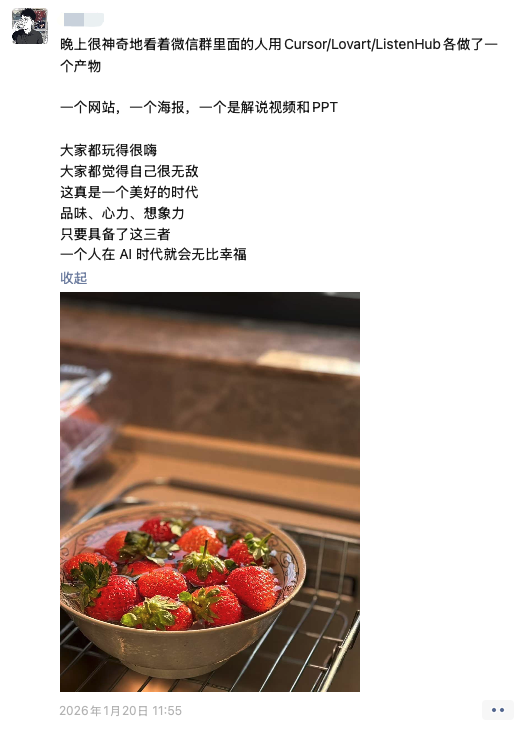
I think these demands always existed; previous productivity levels just couldn’t satisfy them. There have always been people who wanted to play beautiful music, but most didn’t have time to practice to that level. There have always been people who wanted to build beautiful websites, but most couldn’t code.
AI is releasing demand that was suppressed by technique barriers. Most of these demands are personalized or niche—not worth a professional’s time to fulfill. Now everyone can DIY, using AI to realize their small ideas.
This may not be “demand expansion” in the traditional sense, but it gives more people the chance to become creators, not just consumers.